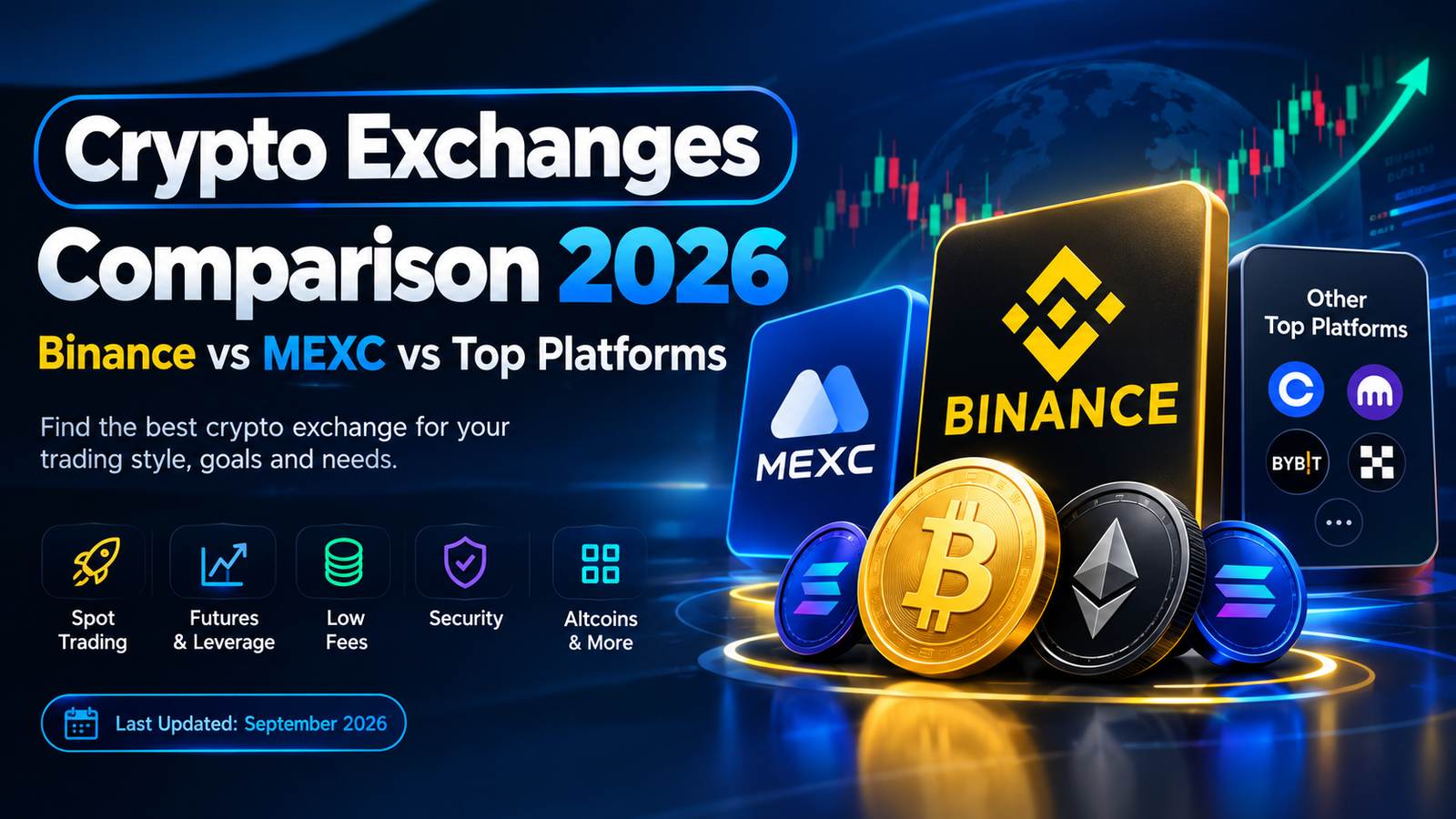
Crypto Exchanges Comparison 2026: Binance vs MEXC and Top Platforms
Last reviewed: September 7, 2026
Choosing a cryptocurrency exchange is about more than finding the lowest advertised trading fee. The exchange you choose can affect the markets available to you, trading costs, liquidity, security options, verification requirements, and the products you can use.
In this guide, we compare Binance, MEXC, Coinbase, Kraken, Bybit, and OKX from a practical trading perspective. Instead of naming one platform as the best for everyone, we explain where each exchange may make sense and what you should check before depositing money.
Important: Cryptocurrency exchange fees, supported assets, leverage limits, promotions, and regional availability can change. Always verify the current terms on the exchange before trading.
Quick Answer: Which Crypto Exchange Is Best in 2026?
There is no single cryptocurrency exchange that is the right choice for every trader. Your choice should depend on what you trade, where you live, how frequently you trade, and whether you need spot, futures, or other crypto products.
- Binance: A broad all-around crypto ecosystem with spot and derivatives markets.
- MEXC: Particularly useful for traders interested in a wide range of altcoin markets.
- Coinbase: A straightforward option for users who prioritize simplicity and supported regulated-market access.
- Kraken: Worth considering if security practices and a detailed trading-fee structure are important to you.
- Bybit: Focused heavily on active trading and derivatives.
- OKX: Combines exchange services with a wider Web3 ecosystem.
Regional availability is important. An exchange may offer a product globally but restrict that product in particular countries or jurisdictions.
How We Compare Crypto Exchanges
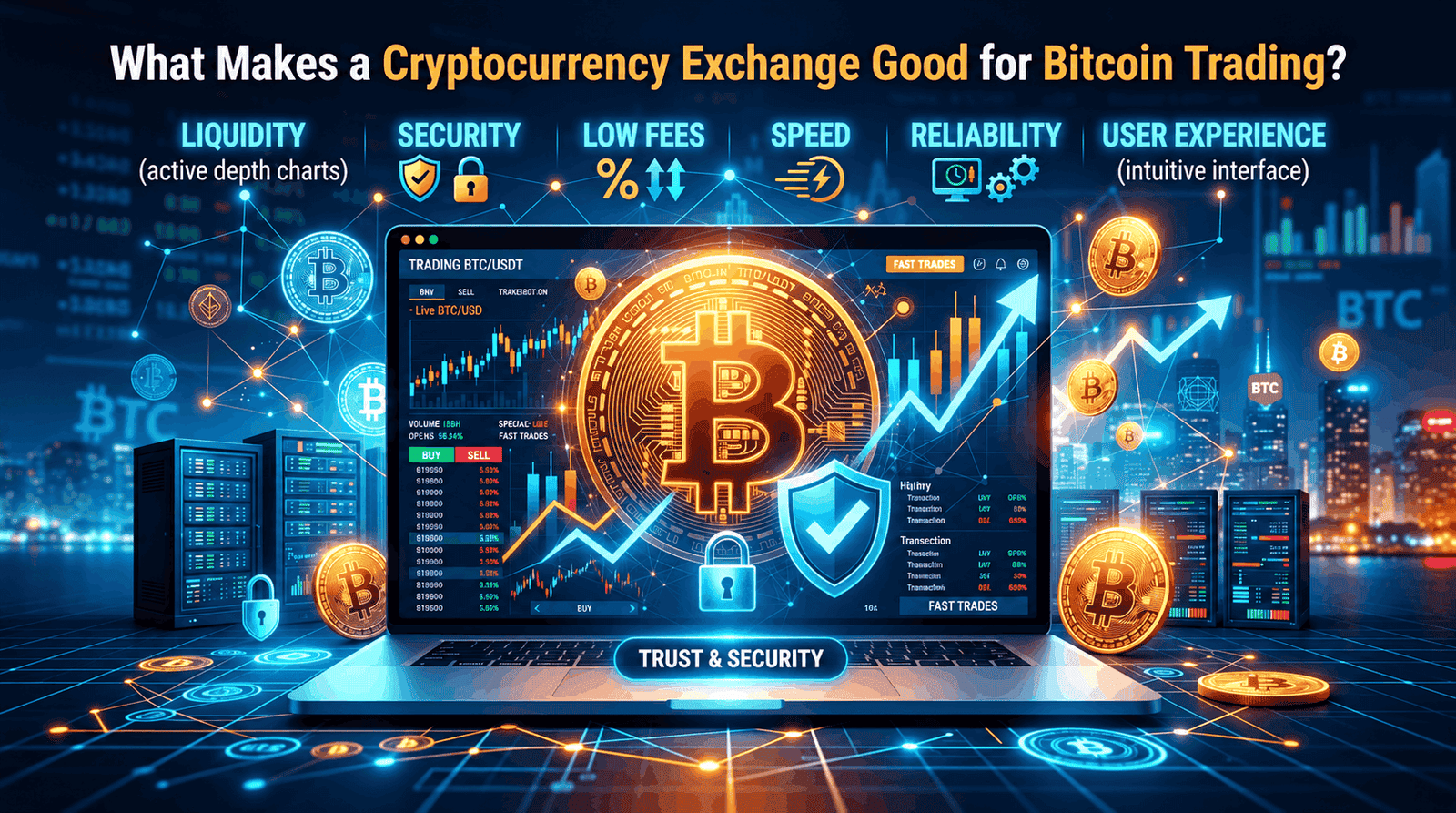
We do not rank exchanges simply by popularity or the number of cryptocurrencies they list. A useful comparison should consider several factors that can affect the actual trading experience.
- Trading costs
- Spot and derivatives markets
- Asset selection
- Liquidity and spreads
- Security features
- Verification requirements
- Trading tools
- Ease of use
- Regional availability
- Additional products and Web3 features
This approach is important because the exchange advertising the lowest trading fee is not necessarily the cheapest place to execute a particular trade.
For example, a low trading fee can be offset by a wider spread, low liquidity, funding costs, or withdrawal charges. Traders should therefore look at the complete cost of using an exchange rather than one headline percentage.
Crypto Exchanges Compared
| Exchange | Main Strength | Best Suited To | Spot | Derivatives |
|---|---|---|---|---|
| Binance | Broad ecosystem | Active and general crypto traders | Yes | Yes |
| MEXC | Wide altcoin-market selection | Altcoin-focused traders | Yes | Yes |
| Coinbase | Simple user experience | Beginners and supported-market users | Yes | Varies |
| Kraken | Security-focused trading | Security-conscious users | Yes | Varies |
| Bybit | Active trading and derivatives | Active traders | Yes | Yes |
| OKX | Trading and Web3 | Traders exploring Web3 | Yes | Yes |
1. Binance
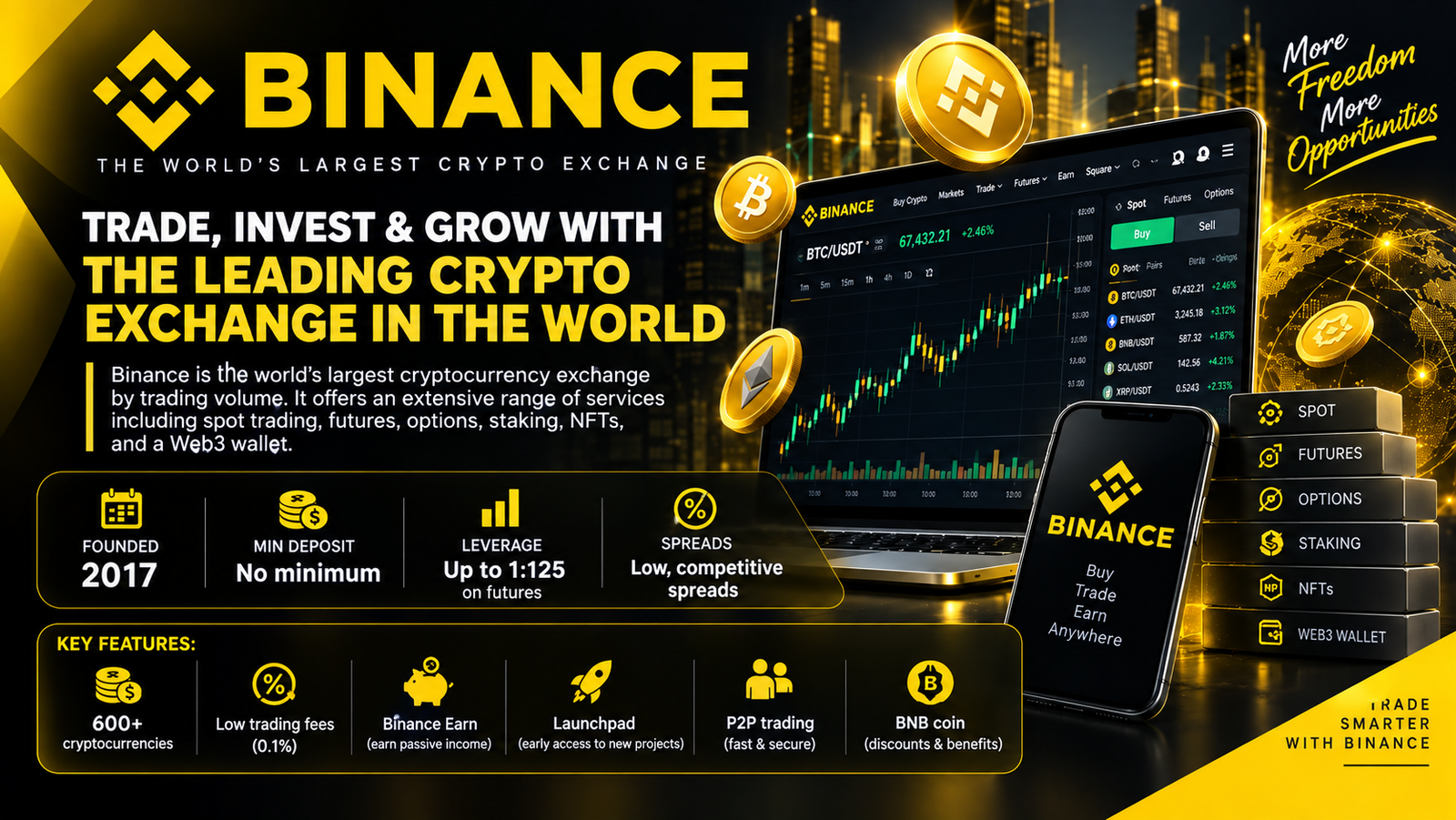
Best for: All-around crypto trading
Binance is a large cryptocurrency trading ecosystem offering a broad range of markets and crypto-related services. Its main advantage is the number of products available to users rather than one specific feature.
For traders who want access to spot markets, derivatives, P2P functionality, earning products, and other crypto services within one ecosystem, Binance can be a practical choice.
What Makes Binance Different?
The main advantage is breadth. Binance provides tools for casual users as well as active traders who need more advanced order types and market-analysis features.
Its published trading-fee schedule uses different rates depending on account level, trading volume, discounts, and applicable conditions. Therefore, the commonly quoted 0.1% spot fee should not be treated as a universal rate for every user or transaction.
Binance Strengths
- Broad crypto trading ecosystem
- Spot and derivatives markets
- Advanced trading and charting tools
- P2P functionality
- Earn-related products
- Web3-related services
- Competitive trading costs for many users
- Strong liquidity on major markets
Binance Limitations
- The large number of features can be confusing for beginners.
- Product availability differs by country.
- Fees depend on the applicable trading tier and product.
- Not every service is available to every account.
Who Should Consider Binance?
Binance may suit traders who want one platform for several types of cryptocurrency activity. If you only plan to purchase Bitcoin occasionally, however, its large feature set may be more than you need.
2. MEXC
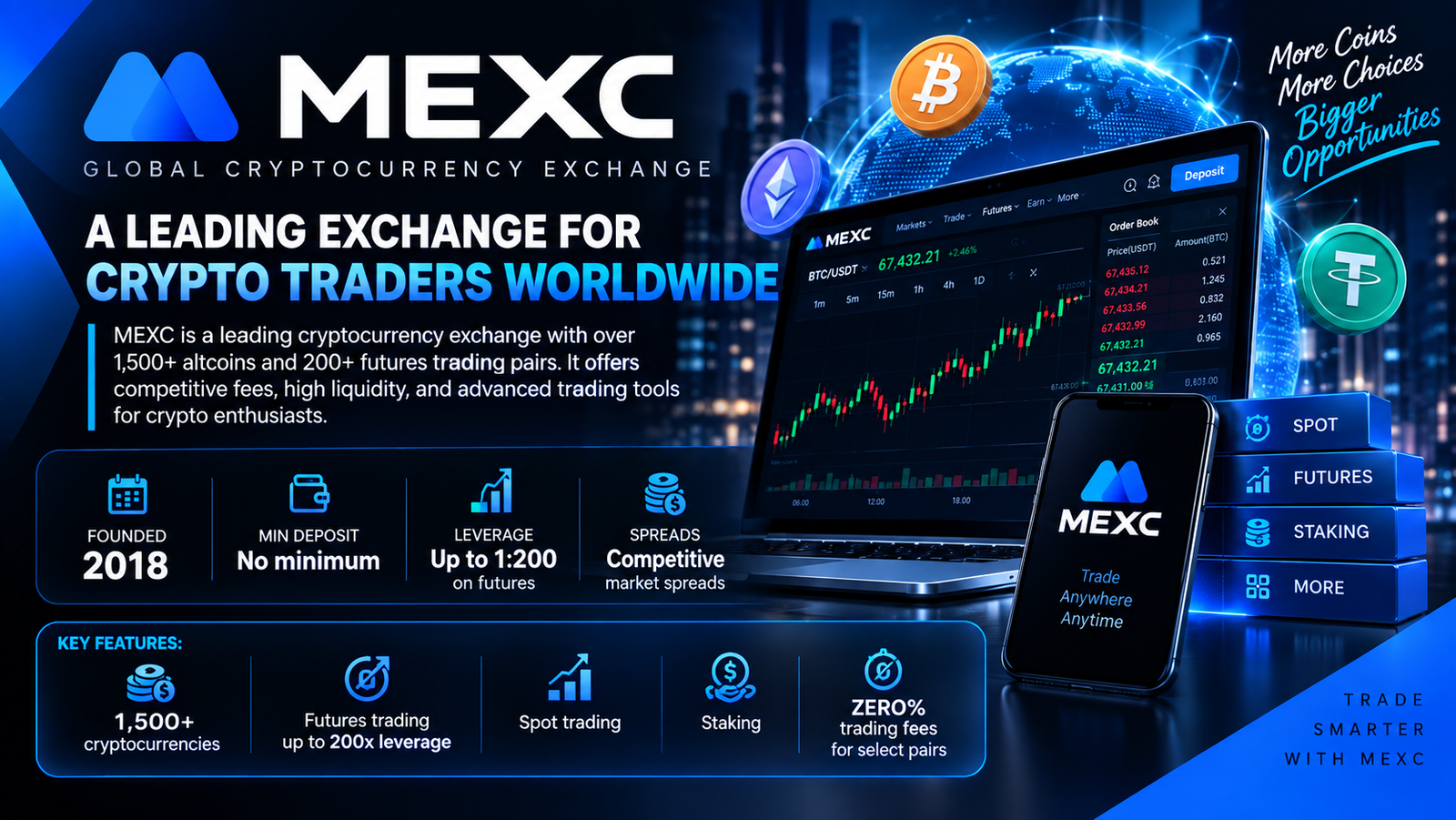
Best for: Traders who prioritize altcoin variety
MEXC has built much of its appeal around the number of cryptocurrency markets available to traders. This can make it interesting for people who regularly research smaller or newer tokens.
However, a large asset list should not automatically be interpreted as a sign that an exchange or a particular token is safer.
What Should You Check Before Trading an Altcoin?
Before buying a smaller cryptocurrency, consider more than whether it is listed on an exchange.
- 24-hour trading volume
- Order-book depth
- Bid/ask spread
- Withdrawal availability
- Supported blockchain network
- Project documentation
- Token contract information
- Recent project activity
- Availability in your country
A listing on a major exchange is not a guarantee that a cryptocurrency project is legitimate or suitable for your portfolio.
MEXC Futures and Leverage
MEXC offers futures trading with high leverage on eligible contracts. Maximum leverage can vary by product, account, and region, so traders should check the current contract specifications before opening a position.
High leverage should not be confused with better trading conditions. Increasing leverage also increases the speed at which a position can reach liquidation when the market moves against the trader.
MEXC Strengths
- Broad range of cryptocurrency markets
- Spot and futures trading
- Advanced trading tools
- Access to a variety of altcoin markets
- Copy-trading and other trading-related features may be available
- Useful for experienced traders researching smaller markets
MEXC Limitations
- Large numbers of markets require additional research.
- Regional restrictions may apply.
- Smaller tokens can have significantly lower liquidity.
- High-leverage products carry substantial risk.
Who Should Consider MEXC?
MEXC may be suitable for experienced traders who deliberately research smaller-cap cryptocurrencies and understand the risks of volatile markets.
Binance vs MEXC: Which One Is Better?
The answer depends on what you trade.
| Category | Binance | MEXC |
|---|---|---|
| Overall ecosystem | Very broad | Broad |
| Spot trading | Yes | Yes |
| Futures | Yes | Yes |
| Altcoin variety | Broad | Particularly strong |
| High-leverage futures | Available on eligible products | Available on eligible products |
| Beginner experience | Can feel complex | Can feel complex |
| Best use case | General-purpose crypto trading | Altcoin-focused trading |
For Major Cryptocurrencies
If you mainly trade Bitcoin, Ethereum, and other highly liquid assets, the total number of coins listed by an exchange may not matter very much.
In this situation, liquidity, spread, fees, security controls, order types, and withdrawal reliability can be more important than the size of the asset list.
For Smaller Altcoins
This is where MEXC can become more interesting. Traders looking for newer or less widely listed assets may find more markets available.
However, additional listings mean additional research. More listed coins do not automatically mean better investment opportunities.
For Beginners
Beginners should avoid choosing an exchange simply because it advertises high leverage or a large number of coins.
Before using advanced products, learn how market and limit orders, stop-loss orders, funding rates, liquidation, margin, and position sizing work.
3. Coinbase
Best for: Users who prioritize simplicity
Coinbase is known for a relatively straightforward cryptocurrency buying and trading experience and has a strong presence in the United States.
Coinbase also offers Advanced trading tools for users who want more control over orders and charts. Fees can vary according to trading activity, product, and account conditions, so a single fixed percentage should not be treated as the universal Coinbase fee.
Why Consider Coinbase?
Coinbase may appeal to users who want a simpler starting point and the ability to move toward more advanced trading tools as they gain experience.
Best suited for: Beginners, users who prefer a straightforward interface, and users in supported jurisdictions.
4. Kraken
Best for: Security-conscious and experienced users
Kraken has a long history in the cryptocurrency industry and provides a detailed fee structure for its trading products.
Its professional trading interface provides access to more advanced tools than a simple cryptocurrency-buying application. Trading fees can vary according to trading volume, product, and maker/taker status.
Why Consider Kraken?
- Detailed trading-fee structure
- Advanced trading functionality
- Security-focused approach
- Established cryptocurrency platform
Specific products and services may not be available in every country.
5. Bybit
Best for: Active traders and derivatives users
Bybit is particularly well known among active cryptocurrency traders and derivatives users.
Depending on the user's location and account, available products may include spot markets, perpetual contracts, derivatives, advanced order types, trading tools, and copy-trading features.
What Should Futures Traders Compare?
- Funding rates
- Maker and taker fees
- Contract specifications
- Liquidation rules
- Order-book liquidity
- Margin requirements
- Risk-management tools
The maximum leverage advertised by an exchange should not be the deciding factor. Very high leverage can cause a position to be liquidated after a relatively small adverse market movement.
6. OKX
Best for: Traders interested in Web3 features
OKX combines centralized exchange functionality with a broader Web3 ecosystem.
Depending on location and product availability, users may have access to spot trading, derivatives, earning products, Web3 wallet functionality, and other decentralized-ecosystem tools.
The broad range of products can be useful for experienced crypto users, although beginners may find the platform more complicated than a simple cryptocurrency-buying service.
Trading Fees: What You Should Actually Compare
One of the easiest mistakes to make when comparing exchanges is looking only at the headline trading fee.
A more realistic way to think about trading costs is:
Total trading cost = trading fee + spread + funding cost + withdrawal cost + other applicable charges
For example, an exchange may advertise a very low trading fee while a particular low-volume market has a wider spread. In that situation, the headline fee alone does not tell you the actual cost of entering and exiting a position.
Maker vs Taker Fees
A maker order generally adds liquidity to the order book, while a taker order generally executes against existing liquidity.
Exchange fee schedules can also contain different tiers based on trading volume, account level, product, promotions, or other conditions.
When comparing platforms, check:
- Maker fee
- Taker fee
- 30-day trading-volume requirements
- VIP or account-level discounts
- Futures fees
- Funding rates
- Withdrawal charges
Security: What Should You Check?
No centralized cryptocurrency exchange should be treated as completely risk-free.
Instead of asking only “Is this exchange safe?”, ask what security controls are available and whether you are actually using them.
Important Security Features
- Two-factor authentication
- Withdrawal protections
- Anti-phishing controls
- Login notifications
- Device and session management
- Withdrawal-address controls
- Account recovery protections
- Security documentation
- Transparency information where available
Protect Your Own Account
Exchange security cannot fully protect an account if the user's credentials are compromised.
- Use a unique password.
- Enable strong two-factor authentication.
- Review active sessions and devices.
- Use withdrawal security controls where available.
- Never share passwords or authentication codes.
- Consider self-custody for cryptocurrency intended for long-term storage.
Should You Keep Cryptocurrency on an Exchange?
Cryptocurrency exchanges are primarily designed to provide trading and related services. If you hold a substantial amount of cryptocurrency for a long period, consider whether you actually need to keep all of it on an exchange.
Self-custody can reduce exposure to exchange-related risks, but it introduces another responsibility: protecting your private keys or recovery phrase.
There is no completely risk-free storage method. The appropriate choice depends on the amount you hold, your technical knowledge, investment horizon, and security practices.
What About KYC?
Know Your Customer requirements vary between exchanges, countries, products, and account types.
Do not assume that an exchange's statement about “no KYC” means every feature can be used without verification.
Verification requirements can differ for:
- Account registration
- Deposits
- Withdrawals
- Fiat services
- Derivatives
- Higher withdrawal limits
- Specific countries or jurisdictions
Always check the current verification requirements applicable to your location.
How to Choose the Right Crypto Exchange
If You Are a Beginner
Prioritize a clear interface, understandable fees, strong account security, educational resources, and straightforward spot trading.
Do not start using high-leverage futures simply because the exchange makes them available.
If You Trade Major Cryptocurrencies
Focus on liquidity, spreads, execution quality, fees, security, and withdrawal reliability.
The total number of listed cryptocurrencies may be relatively unimportant if you only trade established markets.
If You Trade Altcoins
Check the availability of the specific assets you want to trade, but also examine their liquidity, spread, trading volume, withdrawal support, and project quality.
Never buy an unknown token simply because it is listed on an exchange.
If You Trade Futures
Compare funding rates, maker/taker fees, liquidation rules, margin modes, contract liquidity, and risk-management tools.
Higher leverage means higher risk, not better trading.
Binance vs MEXC: Our Practical Verdict
There is no universal winner between Binance and MEXC.
Choose Binance if:
- You want a broad crypto ecosystem.
- You mainly trade major cryptocurrencies.
- You need advanced spot or derivatives tools.
- You want several crypto services within one platform.
Consider MEXC if:
- You actively research altcoins.
- You want access to a broad selection of cryptocurrency markets.
- You understand the risks associated with smaller-cap assets.
- You are comfortable using advanced trading products.
The More Useful Question
The decision should not simply be:
“Which exchange has the most coins?”
A better question is:
“Which exchange provides the markets, liquidity, costs, security controls, and features that match the way I trade?”
That approach produces a much more useful exchange comparison than choosing a platform based on one headline number.
Our Crypto Exchange Picks by Use Case
| Use Case | Exchange to Consider |
|---|---|
| Broad all-around crypto ecosystem | Binance |
| Wide altcoin-market selection | MEXC |
| Simple cryptocurrency experience | Coinbase |
| Security-conscious trading | Kraken |
| Active derivatives trading | Bybit |
| Trading plus Web3 ecosystem | OKX |
These are use-case categories rather than guarantees or financial recommendations. The right exchange for one trader may be unsuitable for another.
Before You Deposit Money
Use this checklist before transferring funds to a cryptocurrency exchange:
- Confirm that the exchange supports your country.
- Read the current fee schedule.
- Check withdrawal limits and fees.
- Confirm that your preferred cryptocurrency is supported.
- Check the correct deposit and withdrawal network.
- Enable two-factor authentication.
- Understand whether you are using spot, margin, or futures.
- Read the current terms for the product you intend to use.
- Start with an amount you can afford to lose.
- Never share your password, recovery codes, or authentication codes.
If you are considering futures trading, understand margin and liquidation before increasing your position size or leverage.
Frequently Asked Questions
Which crypto exchange is best in 2026?
There is no single best exchange for every user. Binance may suit traders looking for a broad ecosystem, MEXC may appeal to users focused on altcoin markets, Coinbase emphasizes simplicity, Kraken offers a mature trading environment, while Bybit and OKX can be attractive to active traders with different product requirements.
Is Binance better than MEXC?
It depends on your trading style. Binance may be a better fit if you want a broad ecosystem and mainly trade major cryptocurrencies. MEXC may be more interesting if your priority is accessing a wider selection of altcoin markets.
Does the lowest trading fee mean the cheapest exchange?
No. Your actual cost can include trading fees, spreads, funding costs, withdrawal charges, network fees, and slippage. Compare the complete cost of the trade rather than one advertised percentage.
Is MEXC safe?
No centralized exchange should be described as completely risk-free. Evaluate the exchange's current security measures, regional availability, account protections, and the risks associated with the specific assets you plan to trade.
Is Binance safe?
Binance provides multiple account-security and platform-protection features, but exchange risk cannot be completely eliminated. Use strong account security and avoid keeping more funds on an exchange than you need for your trading strategy.
Which exchange has the most altcoins?
The answer changes over time as exchanges add and remove markets. Instead of relying on a fixed coin-count claim, check the current market list and evaluate liquidity and withdrawal support for the specific asset you want to trade.
Can beginners use futures trading?
Futures may be available to beginners on some platforms, but availability does not mean they are appropriate for beginners. Leverage can magnify losses and liquidation can happen quickly. Learn spot trading, margin, position sizing, funding, and liquidation before considering leveraged products.
Do crypto exchanges require KYC?
Requirements vary by exchange, country, product, and transaction limits. Always check the current KYC requirements that apply to your jurisdiction and the specific service you want to use.
Final Verdict
The best cryptocurrency exchange is the one that fits your actual requirements rather than the one with the most impressive headline numbers.
Binance is worth considering for users who want a broad all-in-one crypto ecosystem.
MEXC may be attractive to experienced traders who prioritize a wide selection of altcoin markets.
Coinbase can appeal to users who prioritize a straightforward experience, while Kraken is worth evaluating for traders who place strong emphasis on security and a detailed trading environment.
Bybit can suit active derivatives traders, while OKX offers a broader combination of trading and Web3 functionality.
Before depositing money, compare the current fees, available markets, security controls, withdrawal conditions, and regional restrictions for your specific situation.
Related Trading Guide
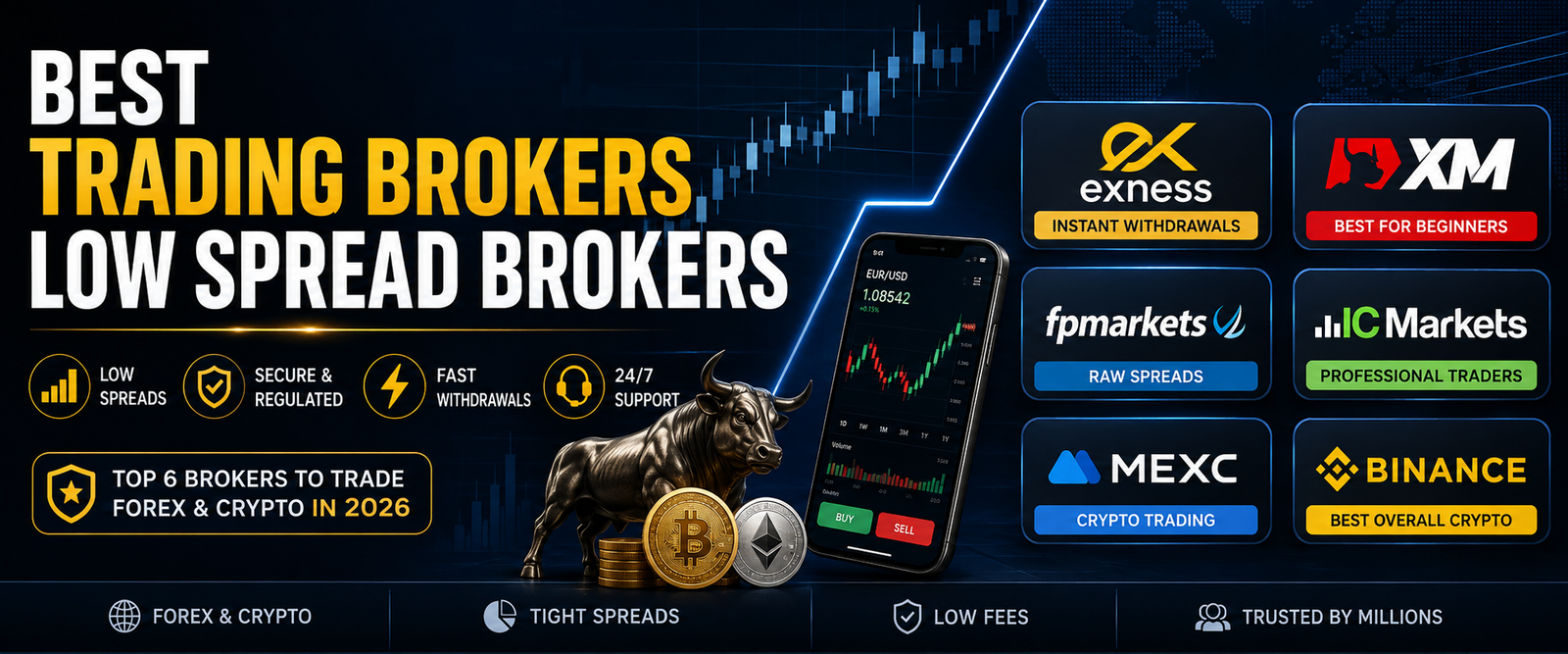
If you are also interested in traditional financial markets, read our guide to Best Trading Brokers and Low Spread Brokers.
Affiliate Disclosure
Some links on this page may be referral or affiliate links. If you sign up through one of these links, SixLytics may receive a commission or other compensation at no additional cost to you.
Affiliate relationships do not change the purpose of this comparison. Exchange features, fees, availability, and terms can change, so readers should verify current information before making financial decisions.
Risk Disclaimer
Cryptocurrency trading involves substantial risk. Digital-asset prices can change rapidly, and leveraged trading can result in significant losses.
Nothing in this article constitutes financial, investment, tax, or legal advice. Conduct your own research and consider your financial situation and risk tolerance before trading.
Last reviewed: September 7, 2026

Comments (0)
No comments yet. Be the first to comment!